

Anxiety at Work: How to Cope and When Counseling Helps. You open your laptop, see another meeting on your calendar, and feel your chest tighten. The workday hasn’t started, but your mind is already running through everything that could go wrong. What if your manager asks something you can’t answer? What if that small mistake from yesterday is the reason for the meeting?
Anxiety at work can turn ordinary tasks into a steady stream of worry. You may reread a simple email five times, prepare for a conversation for hours, or replay a comment from your supervisor long after you’ve logged off. Practical tools can help, and anxiety at work counseling can give you extra support when the worry starts running your days.
At Inspirational Behavioral Healing (IBH), we work with adults who feel this pressure every week. This guide explains what workplace anxiety looks like, why work triggers it, what you can do during the day, and when it may be time to talk to a professional.
What Does Anxiety at Work Look Like?
Workplace anxiety rarely looks dramatic. Many people keep meeting deadlines while struggling in private. From the outside you look fine. On the inside you feel tense, on guard, and tired.
Common signs include:
- Dread on Sunday night or before you log in
- Checking and rechecking emails, reports, or messages
- Trouble concentrating, even on simple tasks
- Fear of criticism or of letting people down
- Avoiding meetings, calls, or presentations when you can
- Headaches, stomach discomfort, or tight shoulders on workdays
- Poor sleep because your mind keeps working at night
- Feeling irritable or drained by the end of the day
The American Psychological Association (APA) notes that work stress can contribute to headaches, stomachaches, sleep problems, a short temper, and difficulty concentrating. If physical symptoms are new or intense, check with a medical provider first. Our guide to physical symptoms of anxiety explains how the body reacts.
Why Does Work Trigger So Much Anxiety?
Work combines several things anxiety reacts to: evaluation, uncertainty, and limited control. Your income, your reputation, and your daily routine all depend on it.
The APA lists excessive workloads, lack of social support, and conflicting demands or unclear expectations among the most common sources of work stress. Other frequent triggers include:
- Performance reviews and feedback
- Speaking up in meetings or presenting
- Conflict with a coworker or manager
- Job insecurity or company changes
- Being always reachable by phone or chat
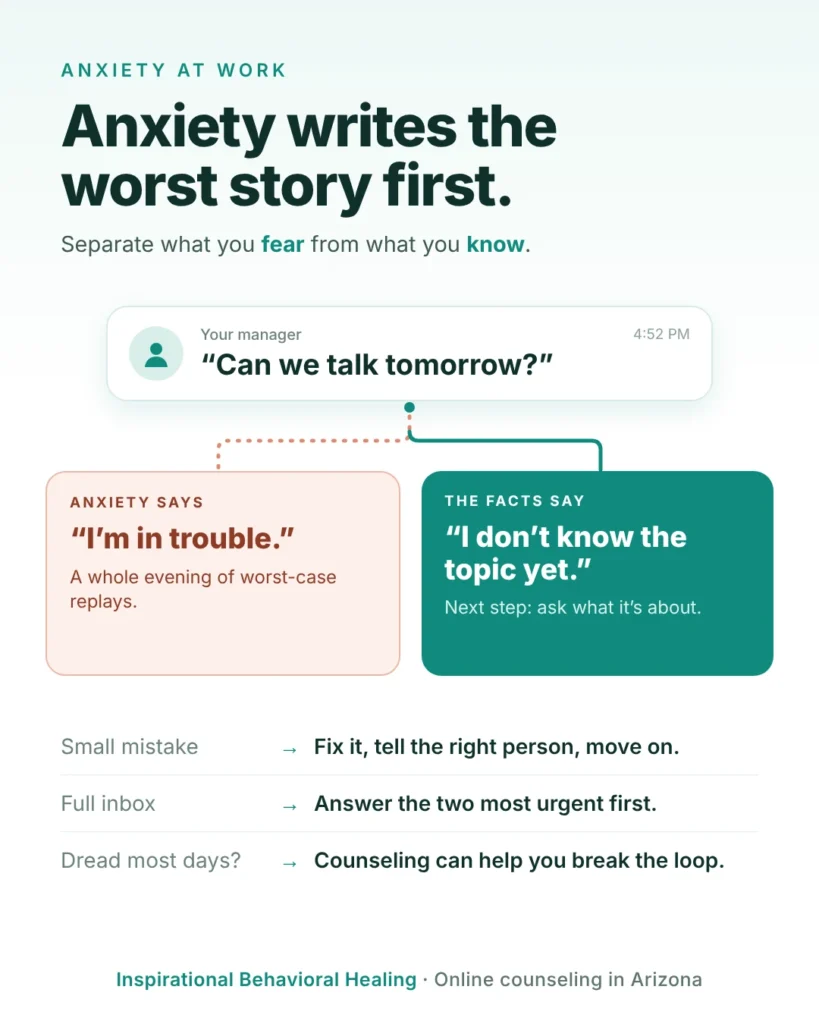
Your history matters too. If a past boss criticized you harshly, a short message like “Can we talk tomorrow?” may set off a full evening of worst-case scenarios. Anxiety fills the gap with the most threatening story it can find, even when you have no facts yet.
Is It Work Stress or Anxiety?
Stress usually has a clear cause and eases when that cause passes. You feel tense before a big deadline and relieved once it’s done. The APA describes anxiety differently: persistent, excessive worry that continues even when no stressor is present. You finish the presentation well, and your mind immediately moves on to the next thing that could go wrong.
Both deserve attention. If you want a deeper comparison, read our article on the difference between anxiety and stress. Workplace anxiety is a description, not a diagnosis. Only a qualified professional can assess whether an anxiety disorder or another concern is involved.
How Can You Cope With Anxiety During the Workday?
You can’t control every deadline or every decision your employer makes. You can change how you respond in the moment, how you handle anxious thoughts, and how you end your day.
When Anxiety Spikes at Your Desk
- Pause and slow your breathing. Breathe comfortably and let the exhale run a little longer than the inhale. Don’t force deep breaths if they make you dizzy.
- Feel your feet on the floor. Notice the chair, the desk, and three things you can see. This brings your attention back to the room.
- Name the trigger. Was it an email, a calendar invite, a tone of voice? Naming it gives your mind something concrete.
- Choose one next step. Not the whole list. One task you can finish in the next 20 minutes.
When Your Thoughts Run Ahead of the Facts
Anxiety often predicts the worst before you have information. Separating what you know from what you fear can lower the pressure.
Work situation | What anxiety tells you | A more useful next step |
Your manager writes “Can we talk tomorrow?” | “I’m in trouble.” | “I don’t know the topic yet. I can ask what it’s about.” |
You made a small mistake | “Everyone will think I’m incompetent.” | “I’ll correct it, tell the right person, and move on.” |
You have a presentation | “I’ll freeze and embarrass myself.” | “I’ll prepare three key points and practice once out loud.” |
Your inbox is full | “I’ll never catch up.” | “I’ll answer the two most urgent messages first.” |
Nobody replied to your idea | “They think it was a bad idea.” | “People are busy. I can follow up in the next meeting.” |
The goal isn’t forced positive thinking. It’s a realistic view that lets you act.
After Hours: How to Close the Workday
Many people feel the worst anxiety once work ends, when the mind replays the day. A short closing routine can help:
- Write down open tasks and when you’ll handle them
- Turn off work notifications at a set time, if your job allows it
- Do something that takes active attention, like a walk, cooking, or a call with a friend
The APA recommends setting work-life boundaries and taking time to recharge, since chronic stress without recovery can lead to burnout.
Should You Talk to Your Manager or HR?

This is a personal decision, and you don’t owe anyone your medical history. Still, some people find that a simple, practical conversation helps. For example: “I do my best work with clear priorities. Can we agree on which of these three projects comes first?”
You may also have resources you haven’t used. Many employers offer an Employee Assistance Program (EAP) with short-term, confidential support. The Anxiety & Depression Association of America (ADAA) notes that the Americans with Disabilities Act protects qualified people with disabilities from job discrimination. If you’re considering formal accommodations, HR or a legal professional can explain your options.
When Is It Time to Seek Anxiety at Work Counseling?
Some nervousness before a big moment is normal. Consider counseling when:
- You dread work most days, not just before hard tasks
- Anxiety affects your sleep, appetite, or relationships
- You turn down opportunities because of fear
- Physical symptoms show up regularly on workdays
- Self-help strategies give you little or short relief
- You’re thinking about quitting mainly to escape the anxiety
The National Institute of Mental Health (NIMH) explains that with an anxiety disorder, the anxiety does not go away and can get worse over time. You don’t need to wait until it feels unbearable.
How Does Counseling Help With Workplace Anxiety?
Counseling gives you a private space to understand your reactions and build skills that fit your actual job. A therapist may help you spot thinking patterns that drive worry, practice the conversations you avoid, and set boundaries you can keep.
Cognitive behavioral therapy (CBT) is one of the most widely used approaches for anxiety, according to the APA. It focuses on changing unhelpful thought patterns. Your plan depends on your symptoms and goals, and some people also benefit from a medical evaluation.
Counseling also helps you sort out a key question: is this mainly an anxiety pattern, or is the job itself unhealthy? At IBH, we look at both your inner patterns and your real circumstances, including how stress shows up in your body. Learn more about how counseling for anxiety helps or what happens in your first counseling session.
Online Counseling for Work Anxiety in Arizona

Finding time for therapy is hard when work already fills your week. Online sessions remove the commute and make it easier to fit care around your schedule.
IBH offers online counseling for adults in Arizona, in English and Spanish, with flexible scheduling. You can join from home or another private space, before or after your workday.
Book Your Free 45-Minute Discovery Call
You don’t have to figure this out alone. Talk with our team about what’s happening at work and whether counseling is a good fit for you.
Book your free Discovery Call, with flexible scheduling that fits your workweek. Prefer to call? Reach our Arizona line at (602) 784-3131.
Frequently Asked Questions About Anxiety at Work
What causes anxiety at work?
Usually a mix of factors. Heavy workloads, unclear expectations, conflict, job insecurity, and frequent evaluation are common triggers. Personal history plays a role too. Someone who was harshly criticized in a past job may feel intense anxiety before every review. A counselor can help you understand which factors affect you most.
How can I calm anxiety quickly during the workday?
Slow your breathing, feel your feet on the floor, and name what triggered the anxiety. Then pick one small task you can complete. Short breaks and a quick walk can also help. If these tools rarely work or the anxiety returns every day, talk with a mental health professional.
Is it normal to feel anxious before work every day?
Feeling nervous before a hard day is common. Feeling dread almost every morning is a signal worth taking seriously, especially if it affects your sleep, mood, or health. It doesn’t mean something is wrong with you, but it does mean you deserve support.
Can counseling help with anxiety at work?
Yes. Counseling can help you understand your triggers, change unhelpful thought patterns, and practice difficult conversations. Approaches like CBT are widely used for anxiety. Progress takes time, and your plan should fit your specific situation rather than a one-size-fits-all program.
Should I tell my employer about my anxiety?
That’s your choice. Some people only ask for practical changes, like clearer priorities, without sharing a diagnosis. Others use their Employee Assistance Program or request formal accommodations. HR or a legal professional can explain your rights before you decide.
Can I get online counseling for work anxiety in Arizona?
Yes. IBH offers online counseling for adults in Arizona, in English and Spanish, with flexible scheduling. You can start with a free 45-minute Discovery Call to talk about your situation and next steps.
This article is for educational purposes and does not replace a professional evaluation. IBH is not an emergency service. If you’re in crisis or thinking about harming yourself, call or text 988 (Suicide & Crisis Lifeline). If you’re in immediate danger, call 911.
Sources
- American Psychological Association: What’s the difference between stress and anxiety?
- American Psychological Association: Coping with stress at work
- National Institute of Mental Health: Anxiety Disorders
- Anxiety & Depression Association of America: Anxiety and Stress in the Workplace