Physical Symptoms of Anxiety You Shouldn’t Ignore. You’ve been to urgent care twice this year. Once for a racing heart that came out of nowhere, once for a tight chest and a wave of dizziness at your desk. Both times, the tests came back normal. You were relieved, and then a little embarrassed, and then worried all over again. If nothing is wrong, why does your body feel like this?
For many people, the answer is anxiety. Not the kind that always shows up as racing thoughts, but the kind that speaks through the body first. A pounding heart, a knotted stomach, sore shoulders, shallow breathing, or sleep that never feels restful can all be physical symptoms of anxiety. And because they feel so physical, they are easy to mistake for something else, or to brush off as “just stress.”
You’re not imagining it, and you’re far from alone. According to the National Institute of Mental Health, about a third of U.S. adolescents and adults experience an anxiety disorder at some point in their lives.
At Inspirational Behavioral Healing (IBH), we see this mind-body overlap every day. Many people reach out not because they feel anxious, but because their body won’t settle down. This guide explains which physical signs are common, why they happen, which ones deserve a doctor’s attention right away, and how speaking with a counselor can help you feel at home in your body again.
Can Anxiety Really Cause Physical Symptoms?
Yes. Anxiety isn’t only a feeling. It’s a whole-body response. (If you want the basics first, start with what anxiety is.)
When your brain senses a threat, real or imagined, it activates your sympathetic nervous system. Harvard Health compares this system to a gas pedal: it triggers the fight-or-flight response and floods your bloodstream with adrenaline. Your heart beats faster, your breathing quickens, your muscles tighten, and you may start to sweat. The American Psychological Association describes the same thing: when anxiety rises, “the body often mobilizes itself to meet the perceived threat.”
That response is useful when you need to jump out of the way of a car. But your nervous system can’t always tell a car from an email from your boss or a conversation you keep replaying at 2 a.m. When the alarm goes off often, or never fully turns off, your body keeps paying the price.
If you’re trying to tell whether you’re dealing with everyday stress or something more persistent, our guide on anxiety vs. stress walks through the difference.
What Are the Most Common Physical Symptoms of Anxiety?
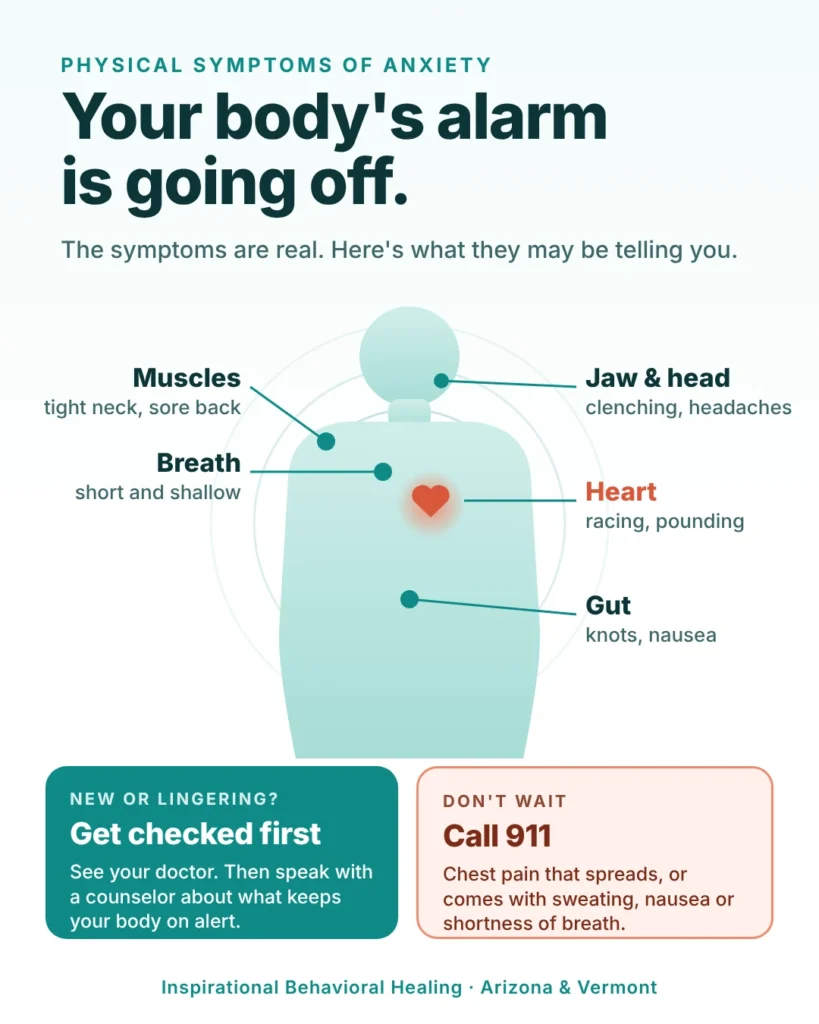
Anxiety can touch almost every system in your body. The NIMH, MedlinePlus, and Mayo Clinic all list physical signs alongside the emotional ones. Here’s how they often show up in daily life.
Heart and Chest
A racing or pounding heartbeat is one of the most frightening physical symptoms of anxiety, and one of the most common. You may feel palpitations, a fluttering sensation, or tightness across your chest. These sensations are part of the fight-or-flight response, but because chest symptoms can also have medical causes, they deserve a careful look (more on that below).
Breathing
Anxiety can make you breathe faster and more shallowly without realizing it. You might feel short of breath, as if you can’t take a full, satisfying breath, or notice a tightness in your throat. Fast breathing can, in turn, cause lightheadedness and tingling, which can make you feel even more on edge.
Stomach and Digestion
Your gut is highly sensitive to stress signals. Anxiety may show up as nausea, stomachaches, cramping, bloating, diarrhea, appetite changes, or that familiar “butterflies” feeling. NIMH notes that people with generalized anxiety disorder may also “make frequent trips to the bathroom.”
Muscles, Head, and Jaw
When your body braces for danger, your muscles tighten, and when that happens day after day, they start to ache. Common signs include tight shoulders and neck, back pain, tension headaches, trembling or twitching, and clenching your jaw or grinding your teeth, often without noticing until the soreness sets in.
Sleep and Energy
Anxiety can make it hard to fall asleep, stay asleep, or wake up feeling rested. It can also leave you drained even after a full night in bed. Running on high alert uses a lot of energy, so fatigue is one of the most overlooked physical symptoms of anxiety.
Dizziness, Tingling, and Other Surprising Signs
Some symptoms catch people off guard: dizziness, tingling in your hands or lips, sweating, hot flashes or chills, trouble swallowing, or cold hands and feet. Because they feel random, many people never connect them to anxiety.
Why Do Symptoms Feel Worse When You Notice Them?
Here’s a pattern many people recognize once it’s named. You notice your heart skipping. You worry something is wrong. That worry triggers more adrenaline. Your heart beats even faster, and now you’re sure something is wrong.
This is the anxiety cycle: the symptom creates fear, and the fear feeds the symptom. Harvard Health describes how physical sensations and anxious thoughts can amplify each other this way.
Understanding the loop doesn’t make the sensations disappear, but it changes your relationship with them. Instead of “Something terrible is happening,” you can begin to think, “My alarm system is turned up right now.” That small shift is often the first step toward calming down.
The table below brings it all together: what you may feel, what may be happening, and when it’s time to involve a doctor.
What you may feel | What may be happening | When to call a doctor |
Racing or pounding heart, palpitations | Adrenaline speeds up your heart rate during fight-or-flight | It’s new, it doesn’t settle with rest, or it comes with chest pain or fainting |
Chest tightness | Tense chest muscles and fast, shallow breathing | Always get new or severe chest pain checked; call 911 if it spreads or comes with sweating, nausea, or trouble breathing |
Shortness of breath | Breathing speeds up and becomes shallow | It’s sudden or severe, or you have asthma, lung, or heart conditions |
Nausea, stomach pain, diarrhea | Stress signals change how your gut moves and feels | Blood in your stool, weight loss you can’t explain, or pain that keeps getting worse |
Headaches, sore neck and shoulders | Muscles stay braced for danger | A sudden, severe headache or one unlike any you’ve had before |
Dizziness, tingling hands or lips | Fast breathing changes how you feel in your body | Fainting, or weakness or numbness on one side of your body |
Fatigue, poor sleep | Your nervous system has a hard time switching off | It lasts for weeks or affects your work, safety, or relationships |
This table is educational, not a diagnosis. Only a medical evaluation can rule out other causes.
When Should a Physical Symptom Not Be Ignored?
This is where many articles stop short, so let’s be clear. Anxiety can cause real physical symptoms, but that doesn’t mean every symptom is anxiety. Mayo Clinic notes that panic attack symptoms can resemble other serious health problems, such as a heart attack, and recommends getting evaluated by your primary care provider if you aren’t sure what’s causing your symptoms.
A good rule of thumb: rule out the medical causes first, and then look at the role anxiety may be playing. Talk with a doctor if a symptom is new, if it’s changing or getting worse, if it doesn’t improve when you calm down, or if you’ve never been checked for it. It’s also worth mentioning if you think your anxiety could be linked to a physical health problem, which Mayo Clinic lists as a reason to see your doctor.
The American Heart Association lists warning signs that always call for emergency care. Call 911 if you have:
- Pressure, squeezing, fullness, or pain in the center of your chest
- Discomfort spreading to your arms, back, neck, jaw, or stomach
- Shortness of breath, with or without chest discomfort
- A cold sweat, nausea, or lightheadedness along with any of these signs
- Face drooping, arm weakness, or trouble speaking, which can be signs of a stroke
You’re never wasting anyone’s time by getting these checked. Normal results are useful information, not a reason to feel embarrassed.
If you’re in crisis or thinking about harming yourself, call or text 988 to reach the 988 Suicide & Crisis Lifeline, available 24/7, free and confidential. In a life-threatening emergency, call 911. IBH is not an emergency service.
What Can You Do When Your Body Is on High Alert?

Once you’ve been medically checked, these simple habits can help your nervous system settle. They won’t replace care, but they can give you some relief in the moment.
- Slow your breathing. Breathe in through your nose for about four counts and out for six. A longer exhale can help signal your body that it can slow down.
- Name what’s happening. Saying “This is my body’s alarm, and it will pass” can interrupt the anxiety cycle.
- Ground yourself in the present. Notice five things you can see, four you can hear, three you can touch. This pulls your attention out of the “what if.”
- Release your muscles. Tense one muscle group for a few seconds, then let it go, working from your shoulders down.
- Move your body. A short walk, stretching, or regular physical activity can help release built-up tension. Harvard Health lists physical activity as one way to counter the stress response.
- Protect your sleep and stimulants. Keep a steady bedtime and pay attention to how caffeine, alcohol, and nicotine affect your symptoms.
If your body still won’t settle, that’s not a failure. It may simply mean you need more support than self-help can offer.
How Can Speaking With a Counselor Help?
Counseling is a well-established way to address anxiety, including the physical side. NIMH notes that treatment for generalized anxiety disorder typically involves psychotherapy, medication, or both, and that cognitive behavioral therapy (CBT) is a research-supported option. MedlinePlus also lists acceptance and commitment therapy as a helpful approach for some anxiety disorders.
In counseling, you can learn to:
- Recognize your body’s early warning signs before they snowball
- Understand what keeps your nervous system on high alert, from current stressors to older patterns
- Break the cycle between frightening sensations and anxious thoughts
- Practice regulation tools that fit your real life, not just the therapy room
- Feel safer and more confident in your own body
At Inspirational Behavioral Healing, care looks at the whole person: mind, body, and the story behind your symptoms. Our integrative model, Full Sanation & Healing Mind, and our psychosomatic therapy work focus on the connection between emotional distress and physical symptoms, so you’re not treated as a list of complaints. For many people, that’s the missing piece after years of “your tests look fine.” You can learn more about how counseling for anxiety helps you feel more in control, or about body-based approaches in our article on somatic healing.
Counseling doesn’t replace medical care; it works alongside it.
Support in Arizona, In Person or Online
IBH works with adults, teens, couples, and families in Arizona and Vermont, where our counselors are licensed. You can choose in-person sessions or online counseling from home, in English or Spanish. If your schedule is packed or leaving the house feels hard on anxious days, online sessions can make that first step easier. You can explore all of our mental health services to see what fits you.
Frequently Asked Questions
Can anxiety cause physical symptoms even if I don’t feel anxious?
Yes. Some people notice body symptoms, such as stomach trouble, muscle tension, fatigue, or a racing heart, before they recognize any worry. Long-term stress can become so familiar that it no longer feels like anxiety, even while your body is still reacting to it.
How long do physical symptoms of anxiety last?
It varies. A sudden surge, like a panic attack, is intensely uncomfortable but usually passes, and Mayo Clinic notes that panic attacks themselves are not dangerous. Ongoing symptoms, like muscle tension, poor sleep, or digestive problems, can last as long as the anxiety behind them goes unaddressed. If symptoms are interfering with daily life, it’s a good time to reach out for support.
How can I tell if chest pain is anxiety or my heart?
You can’t reliably tell on your own, and neither can an article. That’s why new, severe, or unexplained chest pain should always be checked by a medical professional. Call 911 if chest discomfort spreads to your arms, back, neck, jaw, or stomach, or comes with shortness of breath, a cold sweat, nausea, or lightheadedness.
Why are my physical symptoms of anxiety worse at night?
At night, there are fewer distractions, so you notice sensations you’d otherwise miss. Worry about sleep itself can also activate your stress response. Calming routines and counseling can help break that pattern.
Can counseling help with physical symptoms of anxiety?

For many people, yes. Approaches like CBT help you understand and interrupt the cycle between thoughts and body sensations, while body-focused and integrative approaches help your nervous system settle. Results are different for everyone, and a counselor can help you find what works for you.
Do I need a diagnosis to speak with a counselor?
No. You don’t need a diagnosis, a referral, or a crisis to start. Many people reach out simply because their body has been on edge for too long and they want to understand why.
Your Body Is Telling You Something
Physical symptoms of anxiety are real, common, and worth listening to. They aren’t a sign that you’re weak or “making it up.” They’re a sign that your nervous system has been working overtime.
Once your doctor has ruled out other causes, you don’t have to keep managing it alone. Inspirational Behavioral Healing offers counseling in Arizona and Vermont, in person or online, in English or Spanish, with a whole-person approach that takes both your mind and your body seriously.
Speak with a counselor. Book a free 45-minute Discovery Call at inspirationalbehavioralhealing.com/reserva or call our Arizona line at (602) 784-3131. Take your time. We’ll be here when you’re ready.
Sources
- National Institute of Mental Health. Anxiety Disorders.
- National Institute of Mental Health. Generalized Anxiety Disorder: What You Need to Know.
- MedlinePlus, U.S. National Library of Medicine. Anxiety.
- Mayo Clinic. Anxiety disorders: Symptoms and causes.
- Mayo Clinic. Panic attacks and panic disorder: Symptoms and causes.
- American Heart Association. Heart Attack, Stroke and Cardiac Arrest Symptoms.
- American Psychological Association. Anxiety.
- Harvard Health Publishing. Understanding the stress response.
- Harvard Health Publishing. Recognizing and easing the physical symptoms of anxiety.
- 988 Suicide & Crisis Lifeline. 988lifeline.org.
This article is for educational purposes and does not replace medical advice, diagnosis, or treatment.