
Panic Attacks: What They Are, What to Do, and How Counseling Helps. Your heart starts pounding out of nowhere. Your chest feels tight, your hands tingle, and a wave of fear rises so fast that you wonder if something is seriously wrong. Maybe you were in line at the grocery store, driving home on a quiet road, or lying in bed. A few minutes later it fades, and you are left shaky, tired, and asking yourself: what just happened to me?
If that sounds familiar, you are not alone, and you are not “going crazy.” What you may have felt is a panic attack. It is one of the most frightening experiences the body can produce, and it is also one of the most treatable. Cleveland Clinic estimates that up to 11% of people in the United States have a panic attack each year.
This guide explains what a panic attack is, what you can do while one is happening, when to get medical help, and how panic attacks counseling helps people feel safe in their own bodies again. At Inspirational Behavioral Healing (IBH), we work with people across Vermont through online counseling in English and Spanish, and we wrote this guide for anyone trying to make sense of their first, or their fiftieth, episode.
What Is a Panic Attack?
A panic attack is a sudden episode of intense fear that triggers strong physical reactions, often when there is no real danger in front of you. Mayo Clinic notes that symptoms usually peak within minutes and that panic attacks themselves are not life-threatening, even though they can feel that way.
What happens inside is your body’s alarm system firing at the wrong time. The fight-or-flight response speeds up your heart and breathing and floods you with energy to escape a threat. The problem is that there is no threat to escape, so the body’s signals start to feel like the danger.
What Does a Panic Attack Feel Like?
Panic attack symptoms vary from person to person, but these are some of the most common:
- A racing or pounding heartbeat
- Shortness of breath or a feeling of choking
- Chest pain or tightness
- Sweating, trembling, chills, or hot flashes
- Dizziness, lightheadedness, or nausea
- Numbness or tingling in the hands or feet
- Feeling detached from yourself or your surroundings
- A strong sense of doom, or fear of losing control or dying
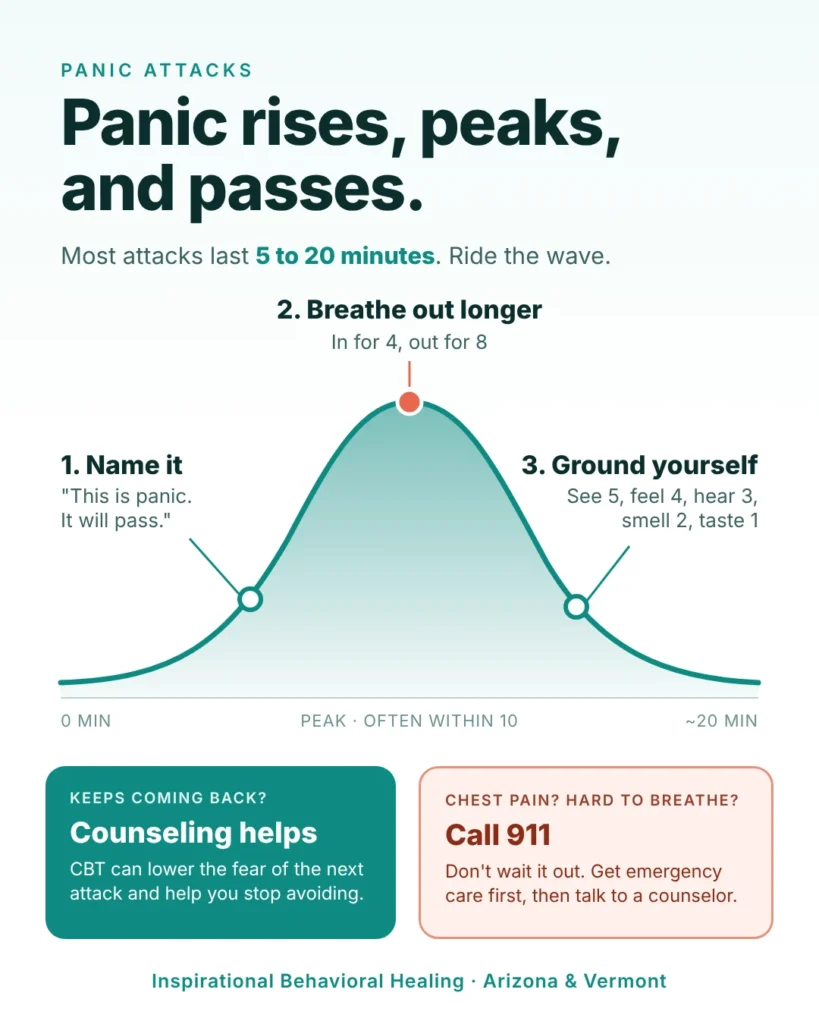
Most panic attacks last between 5 and 20 minutes, according to the NHS and Cleveland Clinic, although some people report episodes lasting up to an hour. Afterward, it is common to feel drained and worn out for a while.
Panic Attack or Panic Disorder?
Having a panic attack does not mean you have panic disorder. Panic disorder is diagnosed when panic attacks are frequent and unexpected and are followed by ongoing worry about the next one, or by changes in how you live to avoid them. You can read more about it in our guide to the 7 types of anxiety disorders. A licensed professional can help you understand which description fits your experience.
What to Do During a Panic Attack
When panic hits, the natural reaction is to fight it or run. Both tend to make the alarm louder. The goal is not to make the feelings vanish on command. It is to ride the wave until it passes, which it does.
The steps below are meant for people whose symptoms have already been checked by a doctor and recognized as panic. If this is your first episode, or something feels different from before, read the next section first.
- Name What Is Happening
Say it plainly, out loud or in your head: “This is a panic attack. It feels awful, but it will pass.” Psychotherapist Jocelyn Nelson, LCPC, writing for The Family Institute at Northwestern University, describes this first step as working with your panic, not against it. Naming it takes away some of the mystery that feeds the fear.
- Slow Down Your Breathing
Fast, shallow breathing can make dizziness and tingling worse. Breathe in gently through your nose, then let a longer breath out through your mouth. One pattern many therapists teach is to breathe in for about four seconds and out for about eight, repeated five to ten times. Comfort matters more than counting. If paying attention to your breath makes you more anxious, skip to the next step.
- Ground Yourself With 5-4-3-2-1
Grounding moves your attention away from the alarm inside and toward the world outside. Look around and name:
- 5 things you can see
- 4 things you can feel, like your feet on the floor
- 3 things you can hear
- 2 things you can smell
- 1 thing you can taste
You do not need to do it perfectly. Its only job is to give your mind something steady to hold on to.
- Let Your Body Soften
Panic tightens the jaw, shoulders, and hands. If you can, sit down, place your feet flat on the floor, and let your shoulders drop as you breathe out. Releasing one muscle group at a time can send your body a quiet signal that you are safe.
- Stay, If You Can
Leaving the situation brings relief in the moment, but it can teach your brain that the place was dangerous. If you are somewhere safe, try to stay and let the wave crest and fall. Every time you do, you collect proof that panic passes on its own.
These skills take practice. If they did not work the first time, that is not a failure. It is a sign that support could help.
When to Seek Medical Help
Panic attack symptoms can look a lot like a heart attack and other serious conditions. Mayo Clinic advises seeking medical help as soon as possible when you have panic attack symptoms, so a doctor can rule out heart, thyroid, and other causes before anyone labels them anxiety.
Call 911 or go to the nearest emergency room if you have chest pain, serious trouble breathing, or you lose consciousness. Do not wait to find out whether it is “just anxiety.” If you are having thoughts of hurting yourself, call or text 988, the Suicide & Crisis Lifeline, available 24/7.
It is also time to talk with a professional if:
- Panic attacks keep coming back
- You worry constantly about the next one
- You have started avoiding places, driving, exercise, or people
- Sleep, work, or relationships are suffering
If your body reacts this way often, our article on physical symptoms of anxiety explains which signs deserve a medical check first.
Why Do Panic Attacks Keep Happening?
Experts do not know exactly why some people have panic attacks. Mayo Clinic lists several factors that may play a role: genetics, major stress or life changes, a traumatic event, a temperament that is more sensitive to stress, and smoking or excessive caffeine. Many attacks come with no clear trigger at all, which is part of what makes them so unsettling.
The Fear of Having Another Panic Attack
For many people, the hardest part is not the attack. It is the fear of the next one. After a bad episode, you start watching your heartbeat and breathing. A small flutter brings the thought, “What if it’s happening again?” That thought raises your anxiety, the anxiety creates more sensations, and the cycle feeds itself.
Over time, the fear can shrink your world. You skip the highway, leave the gym, turn down invitations, or avoid the store where it happened. Each avoided place feels safer for a moment but makes the next challenge feel bigger. Breaking this cycle is one of the main goals of counseling.
How Counseling for Panic Attacks Helps
Coping skills help in the moment. Counseling for panic attacks works on what keeps the alarm going off. Mayo Clinic calls psychotherapy, also known as talk therapy, an effective first choice for treating panic attacks and panic disorder. Cleveland Clinic adds that with treatment, most people who experience panic attacks get better.
Cognitive Behavioral Therapy for Panic Attacks
Cognitive behavioral therapy (CBT) looks at how thoughts, body sensations, and actions feed one another. Imagine that a racing heart instantly means “heart attack” to you. In CBT, you learn to notice that interpretation, test it, and respond in a calmer way.
CBT for panic often includes gradual exposure. With your therapist, you safely bring on some of the sensations you fear, such as a faster heartbeat, and you slowly return to places you have been avoiding. The point is to learn from your own experience that these sensations are uncomfortable but not dangerous.
Mayo Clinic notes that symptoms may start to ease within several weeks, and often improve significantly within several months. Some people also benefit from medication, which must be prescribed and monitored by a medical provider.
What to Expect From Your First Sessions
Your first sessions focus on understanding you. Your counselor may ask when the attacks started, what they feel like, what happens before and after, and what you have stopped doing because of them. Together you set clear goals, such as:
- Understanding your personal panic cycle
- Practicing breathing and grounding skills until they feel natural
- Returning, step by step, to places and activities you have avoided
- Lowering the fear of fear
- Building confidence for the moments that used to stop you
If you want to know more about how that first meeting works, read what happens in your first counseling session or our guide on how counseling for anxiety helps.
At IBH, our approach also pays attention to the connection between mind and body. That can make a real difference when panic shows up mostly as physical sensations.
Online Panic Attacks Counseling in Vermont

When panic makes driving or crowded waiting rooms feel hard, getting to an appointment can become one more obstacle. Online counseling removes that step. You meet your counselor by video from a place where you already feel safe, whether you live in Burlington, Rutland, the Northeast Kingdom, or a small town between them.
IBH offers telehealth counseling with counselors licensed in Vermont and Arizona, in English and Spanish. Being able to describe fear in your own language makes it easier to put hard feelings into words. If you are not sure whether virtual sessions are right for you, our article on online vs. in-person counseling can help you decide.
Online counseling is not the right fit for every situation. Your counselor will help you decide if it meets your needs, and will point you to other care when something else is needed.
Frequently Asked Questions About Panic Attacks
What is the difference between a panic attack and panic disorder?
A panic attack is a single episode of intense fear with strong physical symptoms. Panic disorder is a condition in which panic attacks happen repeatedly and unexpectedly, followed by ongoing fear of more attacks or changes in behavior to avoid them. Many people have one or two panic attacks and never develop panic disorder.
How long does a panic attack usually last?
Most panic attacks last between 5 and 20 minutes, and symptoms usually peak within the first few minutes. Some people report attacks lasting up to an hour, or several waves close together. Feeling tired and shaky afterward is common. If symptoms are new or severe, get medical help instead of waiting them out.
Can panic attacks happen without warning?
Yes. Many panic attacks have no clear trigger. They can start while you are relaxing, driving, or even sleeping. That does not mean the attack is “in your head” or that you did something wrong. Counseling can help you notice hidden patterns and respond with less fear when an attack starts.
Can counseling help prevent future panic attacks?
For many people, yes. Approaches such as CBT can reduce how often panic attacks happen, how intense they feel, and how much they control your life. Counseling cannot promise you will never feel panic again. It can teach you to respond in a way that keeps panic from taking over.
What should I do if panic attacks keep happening?
Start with a medical checkup to rule out other causes. Then keep a simple note of when the attacks happen, what you feel, and what you avoid afterward. Bring it to a mental health professional. Recurring panic attacks are a clear signal that counseling may help, not something you have to live with.
Can I get online counseling for panic attacks in Vermont?
Yes. IBH offers online counseling for people in Vermont, with counselors licensed in the state and sessions in English or Spanish. You can start with a free 45-minute Discovery Call to talk about what you are going through and see if our approach is a good fit.
Get Support for Panic Attacks
Panic attacks can make ordinary days feel unpredictable. With the right support, you can understand what your body is doing, learn skills that work for you, and get back to the places and people you have been missing.
At Inspirational Behavioral Healing, we are here for you, in English or Spanish, from anywhere in Vermont.
Get support for panic attacks: book your free 45-minute Discovery Call
Prefer to talk first? Call our Vermont line at (802) 316-7070.
IBH is not an emergency service. If you are in immediate danger, call 911 or go to the nearest emergency room. For a mental health crisis, call or text 988.
This article is for educational purposes and does not replace a medical evaluation, diagnosis, or individual treatment.
Sources
- Mayo Clinic. Panic attacks and panic disorder: Symptoms and causes. March 14, 2026.
- Mayo Clinic. Panic attacks and panic disorder: Diagnosis and treatment. March 14, 2026.
- Cleveland Clinic. Panic Attacks & Panic Disorder. February 12, 2023.
- NHS. Panic disorder. Reviewed August 22, 2023.
- Nelson, J. The Family Institute at Northwestern University. How to Work Through a Panic Attack. April 29, 2025.
- Mental Health First Aid Australia. Panic Attacks: Mental Health First Aid Guidelines. Revised 2021.