
Social Anxiety: When Situations Feel Overwhelming. You said yes to the dinner a week ago. Now it’s tonight, and your mind is already running the evening in fast-forward. Who will be there? What if you have nothing to say? What if your voice shakes, or your face turns red, or everyone notices? By the afternoon, you’ve drafted the “something came up” text three times. Canceling brings instant relief, followed by that familiar heaviness: Why is this so hard for me when it seems so easy for everyone else?
If that sounds like you, you’re not being dramatic, and you’re not alone. The National Institute of Mental Health estimates that 12.1% of U.S. adults experience social anxiety disorder at some point in their lives. Many of them spend years thinking they’re “just shy” or that this is simply who they are.
At Inspirational Behavioral Healing (IBH), we talk with people every week who have quietly organized their lives around avoiding the spotlight. This guide explains what social anxiety is, how it differs from shyness, why avoiding situations tends to make it stronger, and what actually happens in social anxiety counseling, so you can decide what your next step looks like.
What Is Social Anxiety, and How Is It Different From Shyness?
Social anxiety disorder, also called social phobia, is an intense and persistent fear of being watched, judged, or embarrassed by others. The NIMH describes it as a common type of anxiety disorder in which people feel strong fear in situations where they may be scrutinized, evaluated, or judged. MedlinePlus adds that the fear is often about doing something that will be embarrassing.
Shyness is a personality trait. A shy person may feel awkward at first, warm up after a while, and still go to the party. Social anxiety is different in three ways:
- Intensity. The fear is far bigger than the situation calls for, and you usually know it.
- Duration. It isn’t a bad week. To be diagnosed, the fear generally has to last at least six months, according to NIMH.
- Impact. It shapes your choices. You skip the meeting, avoid the phone call, eat lunch alone, or turn down the promotion that would put you in front of people.
Social anxiety can show up in many situations or only in a few. Some people feel it mainly when they perform or speak in public. Others feel it in almost every interaction, from ordering coffee to answering a text. It usually starts in childhood or the teenage years, and it rarely fades on its own. The NHS notes that for many people, it does not go away without treatment.
If you want the bigger picture first, our guides on what anxiety is and the 7 types of anxiety disorders explain where social anxiety fits.
What Does Social Anxiety Feel Like?
From the outside, social anxiety can look like nothing at all. From the inside, it often happens on three levels at once.
In Your Thoughts
Before a situation, you may replay every way it could go wrong. During it, you watch yourself as if from the outside, checking how you sound and look. Afterward, you may go over the conversation for hours, collecting evidence that you said something wrong. Thoughts like “They think I’m boring” or “Everyone can see I’m nervous” feel like facts, not guesses.
In Your Body
Social anxiety is not only in your head. Common physical signs include blushing, sweating, trembling, a racing heart, nausea, a shaky voice, or a mind that suddenly goes blank. For many people, the fear that others will notice these signs is the hardest part.
In What You Do
To get through, people with social anxiety often rely on quiet strategies called safety behaviors: rehearsing sentences in advance, avoiding eye contact, holding a drink so their hands don’t shake, staying near one trusted person, or staying on their phone. And sometimes, they don’t go at all.
Why Does Avoiding Situations Make Social Anxiety Stronger?
Avoidance feels like the solution, and in the short term it works. You cancel, and the dread drops. The problem is what your brain learns from that relief.
Every time you avoid a situation, your nervous system files it as “dangerous, and I escaped.” You never get the chance to see that the conversation would probably have been fine, or that you could have handled it even if it felt awkward. So next time, the fear shows up a little earlier and a little louder.
Safety behaviors work the same way. If you rehearse every sentence and the conversation goes well, your mind credits the rehearsal, not you. Over time, your world can shrink: fewer invitations accepted, fewer risks taken, fewer chances to discover that people are often kinder and less focused on you than your anxiety predicts.
Seeing this cycle is not a reason to blame yourself. Avoidance is a very human response to fear. It’s simply the reason why gentle, step-by-step practice is at the center of most effective care.
When Is It Time to Talk to Someone?
Feeling nervous before a job interview or a first date is normal. Consider talking with a counselor if:
- You’ve been avoiding situations you care about for months
- Fear is affecting your work, school, friendships, or dating life
- You spend hours worrying before events or replaying them after
- You’ve turned down opportunities because they involve being seen or heard
- You use alcohol or other substances to get through social situations
- You feel lonely, low, or hopeless because of how limited life has become
NIMH notes that social anxiety disorder often occurs alongside depression, other anxiety disorders, and alcohol or substance misuse, which is one more reason not to wait it out alone. You don’t need a diagnosis or a crisis to reach out. Our article on 10 signs you might benefit from a counselor can help you think it through.
If you’re in crisis or thinking about harming yourself, call or text 988 to reach the 988 Suicide & Crisis Lifeline, available 24/7, free and confidential. In an emergency, call 911 or go to your nearest emergency room. IBH is not a 24/7 emergency center.
What Happens in Social Anxiety Counseling?
Many people put off counseling because they imagine being put on the spot, which is exactly what they fear. Good social anxiety counseling works the other way around. It moves at a pace you agree to, and it starts with understanding before it asks for any change. (If it’s your first time, here’s what happens in your first counseling session.)
According to NIMH, treatment for social anxiety disorder usually involves psychotherapy, medication, or both. The NHS states that cognitive behavioral therapy (CBT) is generally considered the best treatment, and NIMH calls CBT the “gold standard” for psychotherapy.
Cognitive Behavioral Therapy (CBT)
In CBT, you and your counselor look closely at the thoughts that fuel your fear, like “If I blush, everyone will think I’m weird,” and test how accurate they really are. You learn to notice the “mind reading” and “worst-case” predictions that anxiety makes, and to replace them with more balanced, realistic ones. You’ll also look at your safety behaviors and how they keep the fear going.
Exposure: One Step at a Time

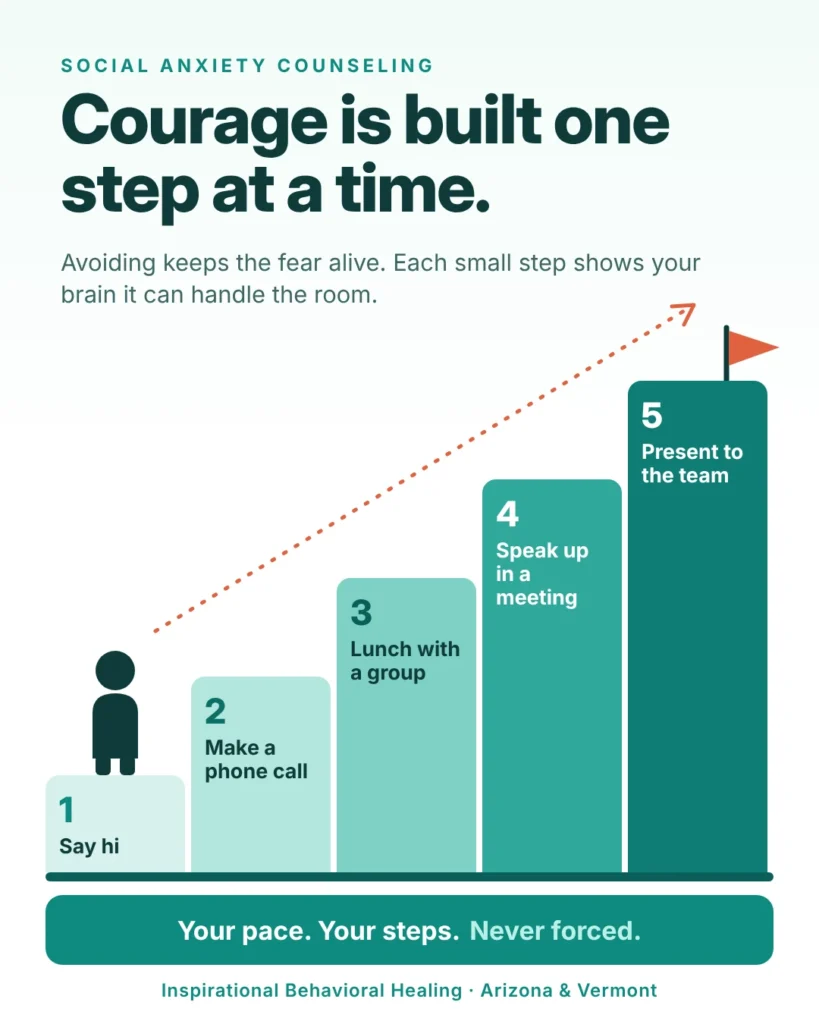
Exposure is a core part of CBT for social anxiety. With your counselor, you build a “ladder” of situations, from mildly uncomfortable to very hard, and practice them gradually. Nothing is forced. You start where it feels challenging but doable, stay with the situation long enough for your body to learn it’s safe, and move up only when you’re ready.
Here is what a ladder might look like for someone who fears speaking up at work:
Step | Practice example | What it builds |
1 | Say good morning to a coworker and ask one question | Tolerating brief, low-stakes attention |
2 | Make a phone call instead of sending an email | Speaking without time to rehearse |
3 | Eat lunch with two or three colleagues | Staying in a group without escaping |
4 | Share one comment in a team meeting | Being heard by several people at once |
5 | Present a short update to the team | Facing the situation you fear most |
This ladder is an example, not a treatment plan. Your steps, order, and pace are built with your counselor around your own goals.
Other Approaches and Medication
NIMH also mentions acceptance and commitment therapy (ACT), which helps you make room for uncomfortable feelings while still doing what matters to you. Some people also benefit from medication, such as certain antidepressants, which should be discussed with a medical provider. Support groups can add connection, but NIMH notes they don’t replace treatment.
At Inspirational Behavioral Healing, social anxiety counseling looks at the whole person, not just the symptoms. Our integrative model, Full Sanation & Healing Mind, considers your thoughts, your body’s stress response, and the story behind your fear, such as past experiences of being criticized or excluded. Progress looks different for everyone. You can read more about how counseling for anxiety helps you feel more in control.
Can Online Counseling Help With Social Anxiety?
For someone with social anxiety, walking into a waiting room can feel like the first exposure step, before therapy has even started. Online counseling removes that barrier. You can talk from a place where you already feel safe, which often makes it easier to open up in the first sessions.
Online care is not a way to avoid the work. Many exposure steps happen in your real life anyway, and you can review them with your counselor afterward. Over time, some people choose to move from video to in-person sessions as part of their own progress. Our guide on online vs. in-person counseling compares both options.
Social Anxiety Counseling in Vermont
IBH’s counselors are licensed in Vermont and Arizona. If you live in Vermont, you can meet with a counselor through our telehealth sessions from anywhere in the state, whether you’re in a busy town or a rural area far from the nearest office, and in-person sessions are also available. Counseling is offered in English and Spanish, so you can talk about your fears in the language you feel most at home in.
Small Steps You Can Try This Week
These ideas won’t replace counseling, but they can help you start loosening the fear’s grip:
- Write it down. After a hard moment, note the situation, what you feared would happen, and what actually happened. The NHS suggests keeping a diary to understand your patterns.
- Slow your breathing. Breathe in through your nose for about four counts and out for six. A longer exhale helps your body settle.
- Shift your focus outward. In conversation, pay attention to what the other person is saying instead of monitoring yourself.
- Drop one safety behavior. Try a short interaction without rehearsing, or make eye contact for a moment longer than usual.
- Take one small step up. Pick something slightly uncomfortable and do it once, not perfectly.
- Be kind to yourself afterward. Notice what you did, not just what felt awkward.
If these steps feel impossible right now, that’s not a failure. It may mean you’d benefit from doing them with support.
Frequently Asked Questions

Is it social anxiety, or am I just shy?
Shyness usually eases as you get comfortable and doesn’t keep you from doing what matters. Social anxiety tends to be more intense, lasts for months, and leads you to avoid situations or endure them with intense fear. Only a qualified professional can make a diagnosis, but if fear is shaping your choices, it’s worth exploring.
How long does social anxiety counseling take?
It varies with each person, their goals, and how long the anxiety has been present. Some people notice changes within a few months of regular sessions; others benefit from longer support. Our article on how long counseling takes to work explains what affects the timeline.
Can online therapy really help social anxiety?
For many people, yes. Online sessions use the same approaches, like CBT and gradual exposure, and they can make it easier to start. Your counselor can help you decide whether online, in-person, or a mix fits you best.
Will I need medication?
Not necessarily. Many people work on social anxiety through counseling alone, while others combine counseling with medication. That decision is made with a medical provider who can review your health history.
Does social anxiety go away on its own?
Sometimes symptoms ease with time, but for many people they persist for years, especially when avoidance keeps the fear in place. The NHS notes that social anxiety often does not go away without treatment.
How can I support someone with social anxiety?
Learn about it, listen without judgment, and avoid pushing them into situations or speaking for them. NIMH also recommends practicing compassion and encouraging professional help when the fear is affecting their life.
You Don’t Have to Face Every Room Alone
Social anxiety can make the world feel smaller, one canceled plan at a time. But it isn’t a character flaw, and it isn’t permanent. With the right support, many people learn to show up for the conversations, opportunities, and relationships they’ve been missing.
If you’re in Vermont and ready to explore social anxiety counseling, Inspirational Behavioral Healing offers sessions online and in person, in English or Spanish, at a pace that feels safe for you.
Start overcoming social anxiety. Book a free 45-minute Discovery Call at inspirationalbehavioralhealing.com/reserva or call our Vermont line at (802) 316-7070. The first step can be small.
Sources
- National Institute of Mental Health. Social Anxiety Disorder: What You Need to Know.
- National Institute of Mental Health. Social Anxiety Disorder (statistics).
- NHS. Social anxiety (social phobia).
- MedlinePlus Medical Encyclopedia. Social anxiety disorder.
- 988 Suicide & Crisis Lifeline. 988lifeline.org.
This article is for educational purposes and does not replace professional advice, diagnosis, or treatment.